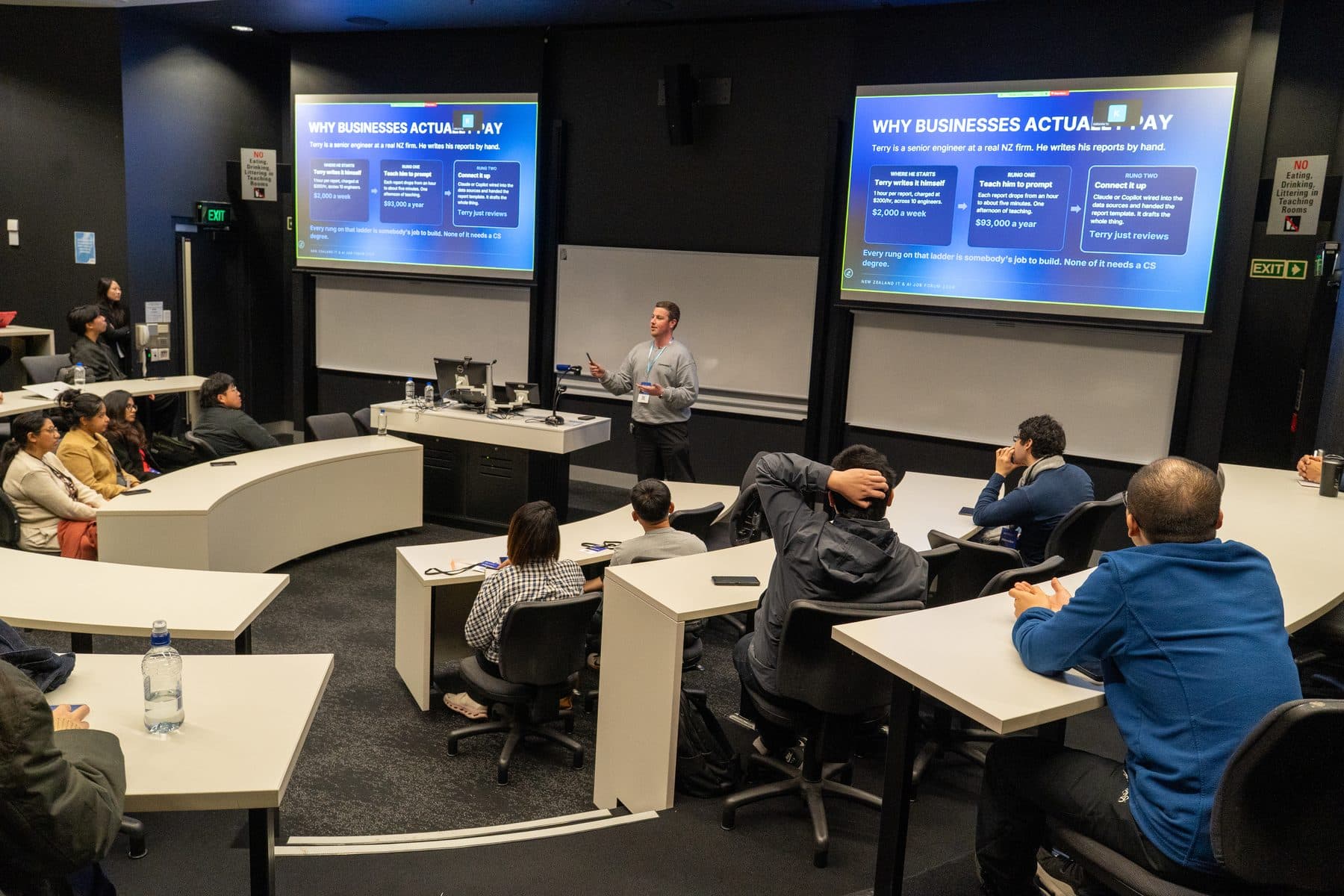
Speaking To New Zealand Students About AI
Written up from the talk with AI assistance, then lightly edited.
Key takeaways
- AI does not replace domain expertise, it multiplies it. The blend of engineering knowledge and AI skill is what makes you valuable.
- Be the magnet, not the applicant. Posting educational content about your work brings in offers that cold applications never will.
- It is only cringe until it works. Almost nobody posts about their actual work, which is exactly why it stands out.
- Critical thinking is non-negotiable. AI is confidently wrong, and you own whatever you pass on unverified.
- Just start. Build something small for a real problem in your life. That is how you learn and how people find you.
In a year and a bit I went from being an electronics student to working as an AI engineer. This talk to New Zealand students is the story of how that happened, and what I think every young person should be doing right now to make the most of where AI is heading.
From the classroom to AI engineering
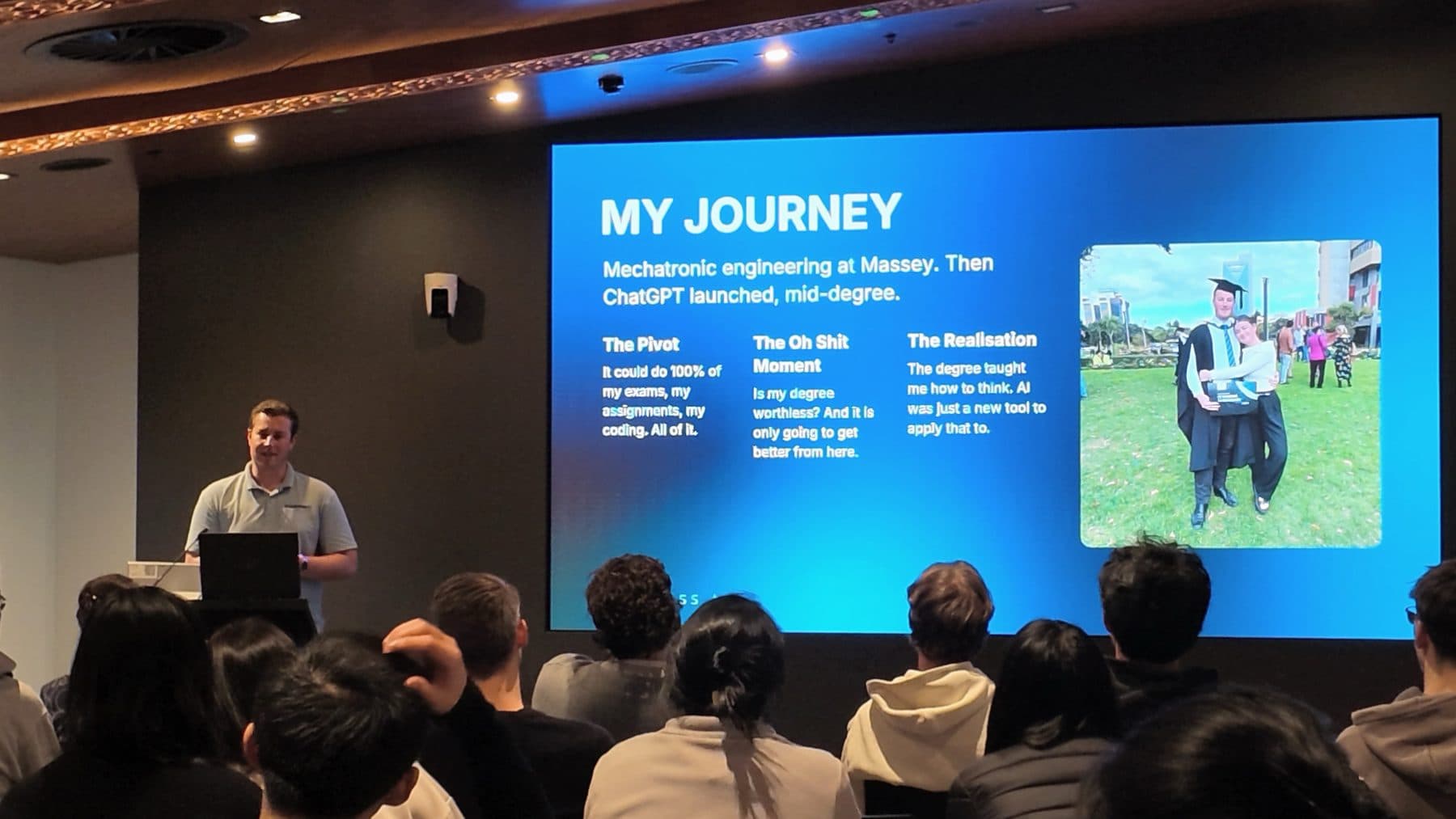
I never set out to work in AI. I originally wanted to be a teacher because I was passionate about education. I coached sport and did tutoring, but the salary pushed me towards engineering instead. I went up to Massey University to do a mechatronics engineering degree, and about halfway through, ChatGPT was released.
I started running my exams and assignments through it and realised pretty quickly that almost everything I was being taught, AI could answer. That was a genuine shock, and for a while I worried about whether the degree was even worth finishing.
I came to the opposite conclusion. The degree was not worthless. It taught me how to solve problems and gave me domain expertise, and AI is simply a tool that lets me do that job far better. That combination, not one or the other, is the whole point.
Learning that the whole market was lost
I took a graduate role at Main Power in North Canterbury, a roughly 140-person company and the only offer I had with even a hint of AI in the description. They essentially handed me a blank slate: go and do AI for us, whatever that means.
A lot of the early work was education. They had rolled out Copilot but nobody knew how to actually use it, how to prompt it, or how to build custom agents. So I taught them, and built chatbots for knowledge retrieval, document comparison and process automation.
I realised quickly how limited you are as a grad. Coming in at the bottom of a 140-person company, people are not going to listen to you, even if you know more about AI than anyone there. So I went looking for where else I could help.
I cold DMed pretty much everyone on LinkedIn with AI in their title, right across New Zealand. I spoke to around 75 people in the first six months. Half replied, half left me on read, and some still have me on read after three or four messages. The real benefit was learning. People love talking about their journey, and through those chats I built a picture of where AI actually sits in New Zealand. The honest answer is that most people are lost. It is moving fast, and they just do not know.
Becoming the magnet
While I was still at Main Power I founded Harkness AI, my own AI consultancy. I knew all this AI stuff and wanted to find clients, so I started cold calling. Cold calling sucks, you get told to get lost constantly, and it is the same grind as applying for jobs. In the graduate market you are competing against 400 people, everyone has an AI-polished CV, and standing out is hard.
So I flipped it. Instead of chasing offers, I wanted to be the magnet that attracts them. I started posting on LinkedIn and YouTube. The early videos were genuinely cringe, you can still go back and watch them, but within six months I had seven job offers across New Zealand and one in Australia, one of them double my salary. All inbound. Zero dollars on ads, no time spent applying.
Almost everyone watches social media. Very few people post, and even fewer post about their actual work. When I was at uni I went looking for real engineers talking about what they do day to day and could barely find anyone, even though that is exactly what a young person wants to see. There is a huge gap, and people avoid it because it feels cringe. But it is only cringe until it works. If a post lands you a job at double the pay, it was never cringe.
I do nothing fancy, I just sit and talk to a camera about AI, and it is close to a million views over eight months. Views themselves do not matter, who is watching does. Because almost nobody in New Zealand is posting about engineering and AI, the audience is highly targeted, it costs nothing, and you become the expert in that niche regardless of your job title.
One thing can change everything
The timeline is simple. I started at Main Power in November 2024, started posting in May 2025, and got my first paying client in August from someone who watched me on YouTube. I hired Alex around the same time, met Karina in November who basically asked what it would take to get me into their business, and I now do three days a week at Patersons while running my own company.
The lesson is that one thing can completely change your life. One coffee chat led to the Patersons role. One YouTube video led to my first paying client. One LinkedIn DM helped me understand the entire market. None of them looked like much on their own, but they compound. It is a snowball effect.
It has also let me work across far more than engineering: electricity, wealth management, mortgage advice, pest control, plumbing. You get to see behind the scenes of how all these businesses actually run, which you never get on the traditional single-industry path.
What the work actually is
Day to day I help with AI strategy and education, working out where AI fits in a business and which processes can be automated, and I build AI-powered web apps, full stack, for internal teams or their customers.
A lot of it is not really AI at all, it is business automation. You would not believe how slow and old most businesses still are, with people manually copying information from one system to another all day. A newer area is AI recruitment: businesses keep asking me to find AI talent, and students keep asking me to find them AI roles. The problem is I cannot find enough talent, largely because most universities still treat AI as cheating and block its use, when in industry the opposite is true. If you can do something faster, why wouldn't you?
The skills that make you valuable
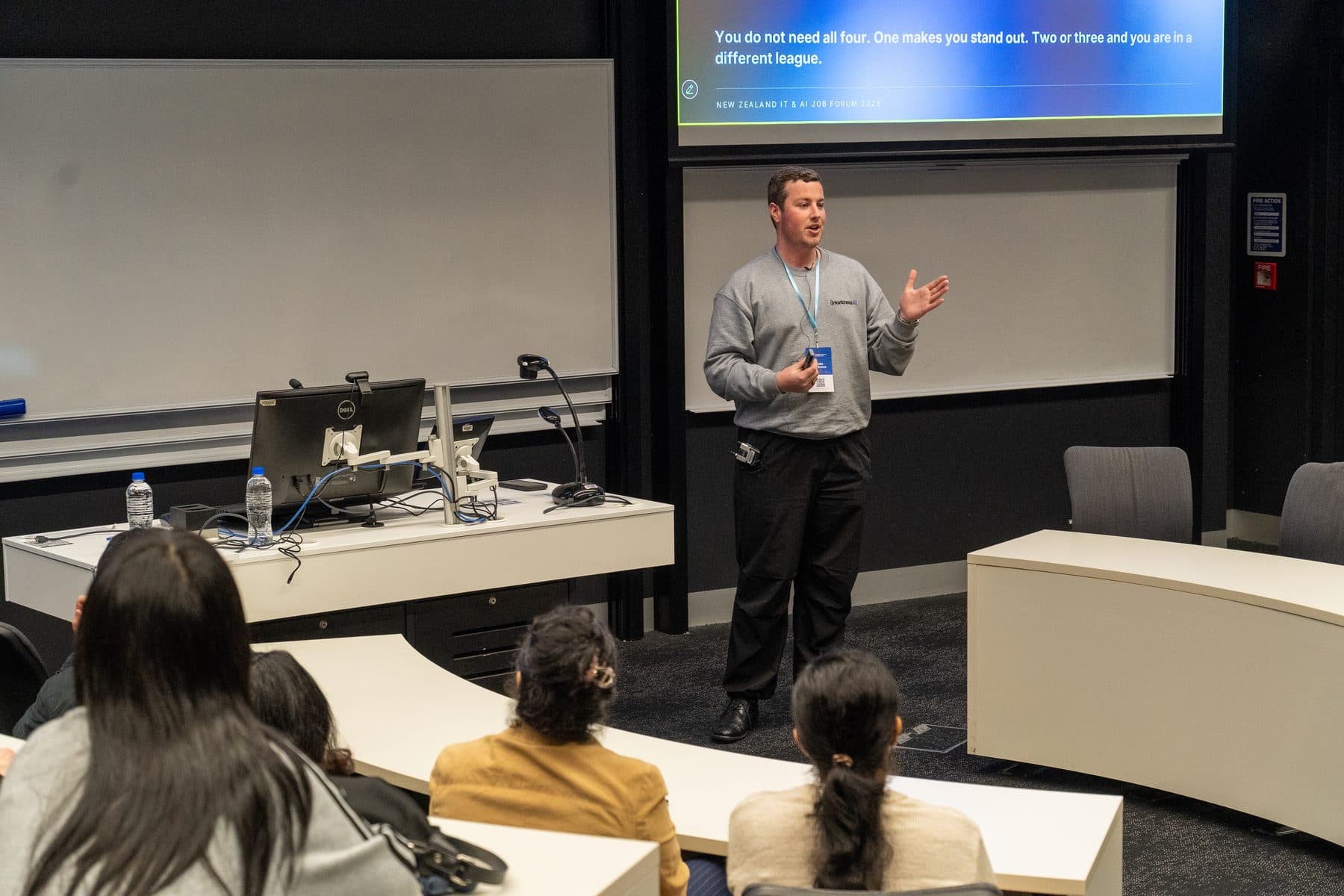
Four things matter. The first is AI tool proficiency: can you use ChatGPT, Claude and coding tools, and do you know which is best for what and how to prompt them well. The second is process automation: in any role, being able to ask why are we doing this the way we have for 20 years, and then make it better, makes you extremely valuable.
The third is domain knowledge. An AI and automation skill set with no understanding of how people actually do their jobs is not enough. It is the blend of the two that counts. Underpinning all of it is critical thinking. AI is powerful but it makes things up, confidently. If a grad generates a polished report that turns out to be garbage and passes it to their manager, they own that. You have to be able to verify and trust what AI gives you.
The number one skill, though, is communication. Not just to your team and managers, but to the models themselves. Large language models are prediction engines, so the better you communicate, the better the output. And as more content becomes AI-generated, genuine human-to-human relationships have never mattered more.
A simple example of the value
Say John spends two and a half hours a week pulling information out of documents, across ten staff. That is around 1,300 hours a year. Teach John to put it through ChatGPT and just validate the output, and he spends 30 minutes instead. At a $100 hourly rate, that is roughly $104,000 of savings, just from teaching people how to use a tool they already have.
How to actually start
Universities and schools are not teaching this, so where do you go? The unhelpful but true answer is to just start. Look at the problems in your own life, your friends', your parents' businesses. My first build was Glow for Less, a little web app for my partner that scans a makeup product, reads the ingredients and finds cheaper alternatives. Nothing to do with engineering, but it taught me how to take someone's problem and build a solution.
The two people I have hired both did exactly this. Alex stood out in his interview because Claude had just released a new model and he had already run his own tests on it. That curiosity, plus a side project, studypoints.net, for indexing lecture notes with AI. Xavier was a first-year civil engineering student who messaged me saying his lecturers were not teaching any AI and asked to work for free. I do not hear many people offer that, so I got him upskilled and he is now on a contract.
That is also why I set up Young Kiwis in AI. Most AI communities are focused on high-level governance and big business. This one is for young professionals. We run free in-person meetups around the country, with talks and member spotlights.
If there is one thing to take away, it is this: just do it. Post something, build a project, talk to someone. The best time to start was yesterday. The second best time is right now.