How Young Kiwis Landed AI Jobs Without a CV
Drafted with AI assistance.
Key takeaways
- CVs no longer work as a filter: AI writes applications and AI screens them, so a role that once got 20 applicants now gets 100 or more.
- Most roles are never advertised. They go to people who knew someone or were already visible on social media.
- Four things beat a CV: real world projects, meeting people in the NZ scene, posting what you learn, and building something for the company before the interview.
- The easiest value to offer is automating manual information moving between systems. Saving 10 people an hour a week at $200 an hour is about $100,000 a year.
- Communication is the key skill: explain problems and solutions clearly to non-technical business owners. Your degree is no longer the moat.
To get an AI job in New Zealand, stop relying on CVs and online forms. Build a real project, meet people in the local scene, post what you are learning, and show up to interviews with something you built.
When I filmed this I had placed five people into AI roles in New Zealand through Young Kiwis in AI, internships and full-time jobs, and none of them got there from a CV. It is 6 now, and the companies that hired them are on our supporters page. I'm hiring myself at the moment, and I've never made a hiring decision based on a CV. AI can now generate a perfect one for anybody, so they're not useful anymore.
I'm an AI engineer who has helped 50+ businesses across New Zealand implement AI, and I run Young Kiwis in AI, a free community of 350+ young people working in or getting into the space. That means I see this from both sides.
This post is the stories: what actually got people hired. If your CV is the thin part and you want the steps, read How to break into AI in New Zealand without a perfect CV.
Is there really an AI job opportunity in NZ right now?
Yes, and it comes from a gap. Universities are structurally five to ten years behind industry, and AI changes month on month. When I spoke to the Master of AI students at the University of Auckland, they weren't being taught how to use AI for software development, or how to apply it to a business. That isn't a dig at the universities. It's just so new.
On the other side, think of how many small businesses in New Zealand have manual, repetitive admin tasks costing huge amounts of time. They know AI matters, but they don't know where it fits or how to implement it. Huge demand, and an education system that isn't producing the talent. You don't close that gap with another qualification. You close it by applying AI to a real problem, and that's genuinely learnable by yourself. Nobody handed me a course. I worked it out on real problems.
What do NZ businesses actually want from AI people?
It's much more basic than people think. The most common request I get: someone in the business spends hours each week pulling information out of one place and putting it into another. Emails, the job system, invoices, into a report or a spreadsheet. That's completely solvable now. If you can connect a tool like Claude into their system and prompt it properly, it can be automated. I cover one version of this in Claude in Excel for NZ business owners, on the Harkness AI site.
Here's the maths that turns you from a student into someone who adds value from day one. Say the people doing this work are charged out at $200 an hour, which is normal for an engineering firm, law firm or accountant. Save 10 people one hour each per week and that's 10 hours, $2,000 a week, call it $100,000 a year. An hour a week is usually a very low bar. None of it needs a computer science degree. It needs you to understand a business problem, communicate, and know which tool is best for the job.
Why is it so hard to get an AI job by applying online?
It's never been easier to get an AI tool to write a job application. Upload your CV, add the job description, and it comes out as a match. A role that used to get 20 applicants now gets 100 or more. The employer can't read them all, so they use AI to screen. AI writes them, AI reads them, and the chance of a human looking at yours is very low.
The part most people don't tell you: the majority of roles never get advertised. They're filled by someone who knew somebody, or someone who was already visible on social media before the job existed. If applying online is your whole strategy, you're in a big pile for the minority of the work.
I saw this hiring a marketing role. A standard form and CV got around 50 applicants, and it was hard to tell them apart. When I hired again, I asked applicants to send a video explaining why they wanted the role. I got a similar number of applications, but only 9 filmed one. The quality was in a different league. People who won't record a two-minute video for a job they say they want filter themselves out, and the video told me far more than a CV.
So do something different. I've seen people print out a massive CV to hand in at the office, bring the employer a cake, or build a demo FAQ chatbot for the website of the company they were applying to. I'm not saying any of these will definitely work, but you need to stand out in an AI CV world.
What matters more than a CV for an AI job?
1. Real world projects. Pick a problem you have, or someone close to you has. A project you care about is one you'll finish. My first was an app called Glow for Less, which scanned makeup and beauty products and found cheaper alternatives with the same ingredients, to save my partner some money. Build something that takes information and puts it somewhere useful. That's what many businesses are buying.
2. Meet people. I'd put this above almost everything else, because most roles never get advertised. Go to local meetups, industry nights and conferences. New Zealand's scene is small enough that you'll be standing next to decision makers, not just recruiters. When I started, I searched LinkedIn for anyone in New Zealand with AI in their job title and messaged 50 plus of them asking for a coffee. Most ignored me, which is fine. Around 20 took me out for a coffee or had an online chat, and I've stayed connected with them. One of those yeses turned into my role at Patersons.
3. Become the magnet. Show people what you're already doing. When I was a graduate at MainPower, I started posting what I was learning about AI as I learned it. Six months of posting almost once a week landed me seven full-time job offers, one at double my salary, and I hadn't applied to any of them. A lot of my business leads still come from social media.
It works because the platforms are good at finding the right audience. Post about AI and it goes in front of people interested in AI, who are overwhelmingly people working in AI or business owners looking for AI help. All it takes is one view, one comment or one message.
One student is an example. He came to a talk of mine on personal branding through Summer of Tech and decided to post an Instagram video every day of his journey to an internship. On day five he landed an internship as an AI engineer. I commented on the post, someone in my network saw it, and it went from there.
How do you stand out in an AI job interview?
Don't just tell them, show them. Before you walk in, build something for that company. A chatbot that answers questions on their own website. A tool that pulls competitor pricing into a spreadsheet. It doesn't have to be good, it just has to be real, on a problem they may actually have. Everyone else describes what they can do. If you're the only one who turned up with a solution, that's an unfair advantage.
Then walk them through it in about 60 seconds: the problem you picked, what you built, how it worked and how you learnt it. Tell them about your failures too. What broke, how did you solve it, how did you overcome it? When we hire, we want to see how someone thinks, not just the finished product, because the real world is full of challenges.
What is the most important AI skill for getting hired?
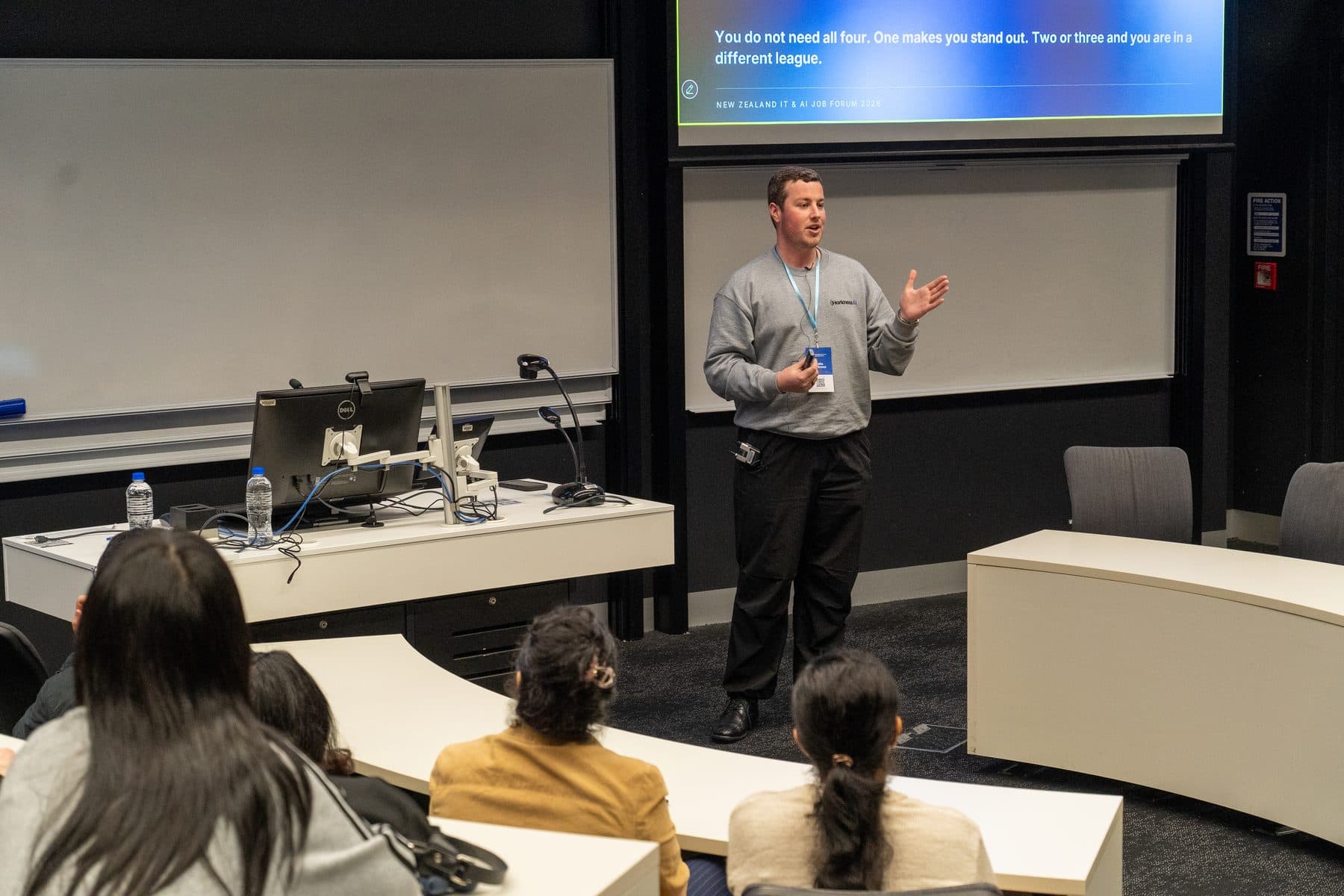
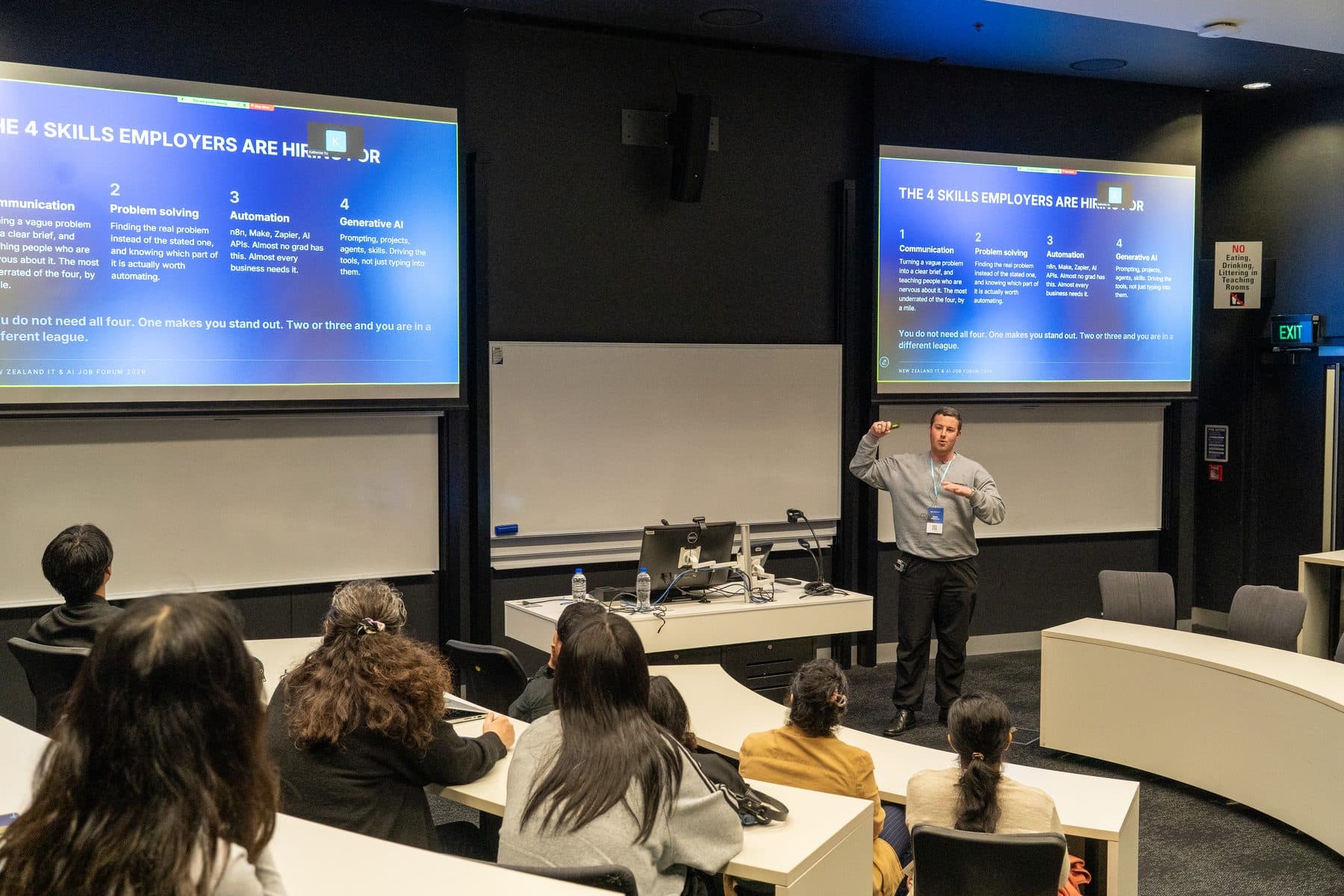
Communication. AI is pattern recognition on human text, so to get good results you have to be a clear communicator: what is the problem, what is the context, here are some examples. Most businesses don't have many technical staff, so you also need to sit down with a business owner, understand their problems and explain what you build to a non-technical audience. Toastmasters is a good place to practise presenting.
The core loop is simple: meet people, build projects, show your work, and build your communication skills. Repeat it and something will happen. It did for me, and it did for those five. For the employer side, AI jobs and internships in NZ: where to actually look covers what they will actually assess you on. For the work itself, see A day in the life of a 23-year-old AI consultant in NZ.
Do you need a degree to work in AI in NZ?
Not really. I was in China this year with a New Zealand AI delegation and we asked a professor at one of the top universities what degree young people should do now. He said it doesn't matter: engineering, humanities, marketing, whatever you like. The only thing that matters is that you use AI alongside it. Your degree is no longer the moat. What you do with it is. For more on that trip, see my 7 days inside China's AI revolution on the Harkness AI site. The longer answer, including when a degree does help, is in How to get into AI in New Zealand.
If you want to join other young people in AI here, Young Kiwis in AI is free, with 350+ members and meetups across New Zealand. There's also a full-day conference on 12 February 2027 in Auckland: the YKIA National Conference 2027.
How do you get an AI job in New Zealand without experience?
Build a real project that solves a problem you or someone close to you has, meet people at local meetups and over coffee, and post what you are learning on social media. The first five people placed through Young Kiwis in AI got their internships and full-time roles this way, not through CVs.
Why am I not hearing back from AI job applications?
AI makes it easy to produce a perfect application, so roles now get 100 or more applicants and employers screen them with AI. The chance of a human reading yours is low, and most roles are never advertised. Stand out with a video, a demo or a personal introduction instead.
What should I do before an AI job interview?
Build the company a small, real demo, such as a chatbot that answers questions on their website. Walk them through the problem, what you built and how you learnt it in about 60 seconds, and include what broke and how you fixed it.
Get new write-ups, jobs and events once a month in the YKIA newsletter.