How to Get Into AI in New Zealand
Drafted with AI assistance.
Key takeaways
- New Zealand businesses mostly need people who can apply existing AI tools to real processes, not people who can build models from scratch.
- A degree genuinely helps for graduate programmes, larger employers and immigration. Some companies, mostly smaller firms, consultancies and startups, will hire on proof without one.
- Get fluent with one assistant, one coding tool and one automation tool. Depth beats breadth, because most tools are the same thing in a different font.
- Build something small that a real person uses, and be able to demo it in sixty seconds. A finished small project beats an impressive unfinished one.
- Post about your work and message people directly. Almost nobody in New Zealand does either, which is exactly why it works.
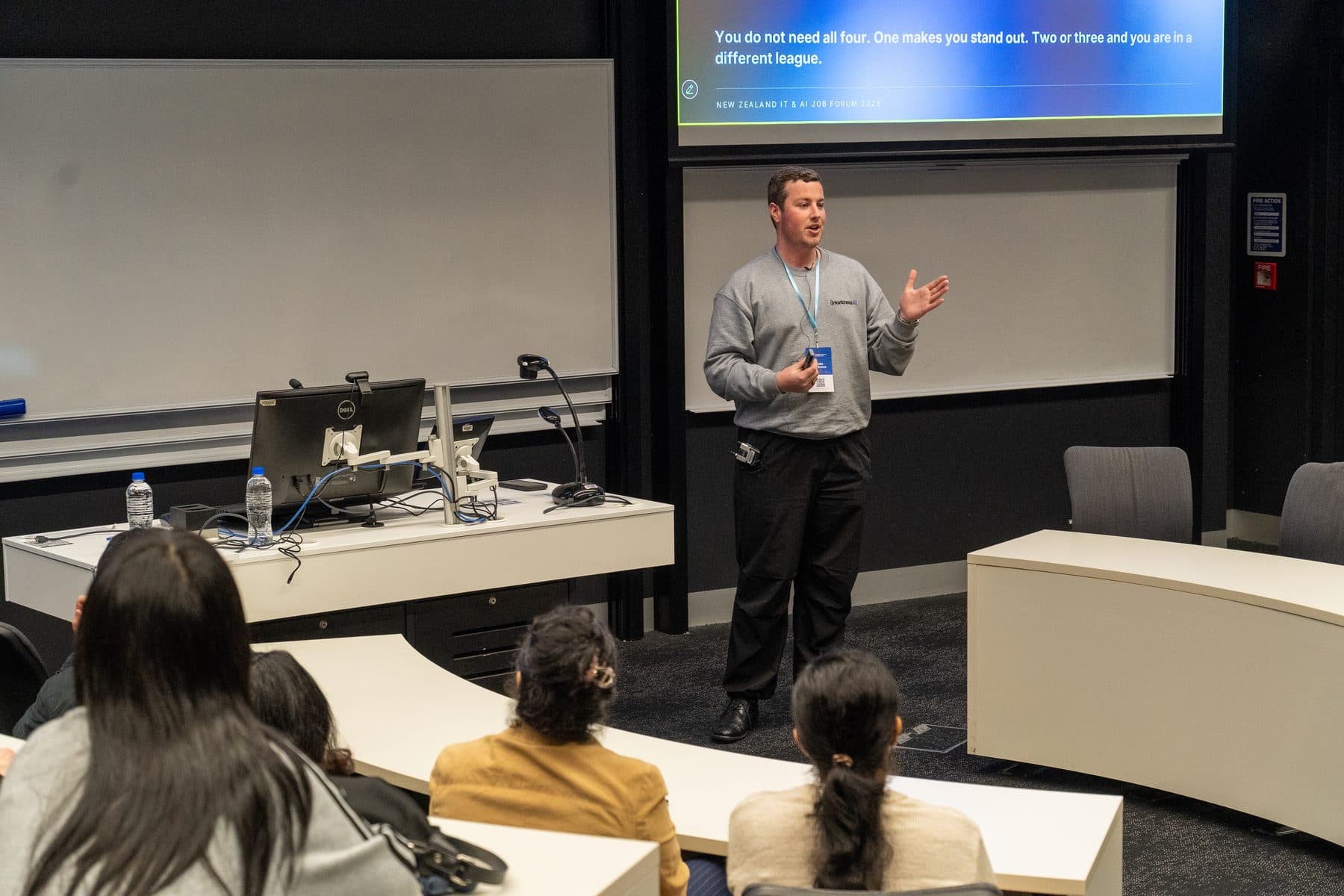
How do I get into AI is the question I get asked more than any other. It usually turns up as a LinkedIn message from a student a year out from graduating, or from someone a couple of years into a job who can see where things are heading and wants in. It is also the talk I give most often, at universities, careers evenings and job forums around the country.
Most of the advice you find online is written for the United States, where the market is enormous and the job titles are specific. New Zealand is not that market. This is the version that actually applies here, in roughly the order I did it.
Start with what New Zealand businesses actually want
Most of this country runs on small and medium businesses. Almost none of them are training models. What they need is someone who can take tools that already exist, work out which process is worth changing, and make that change stick. A lot of it is not even AI, it is business automation with a bit of AI in the middle. You would not believe how many people still spend their day copying information from one system into another by hand.
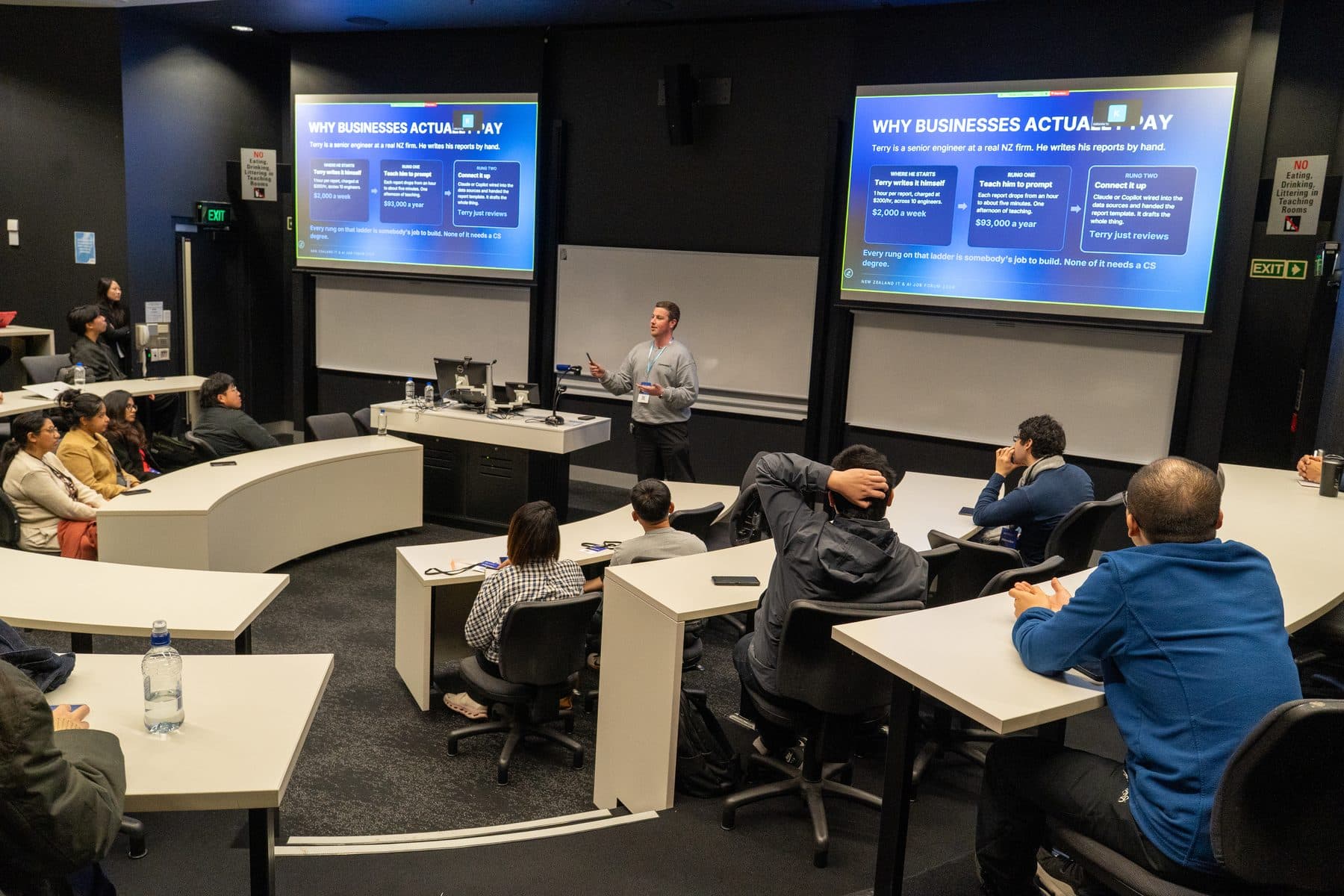
The example I use in almost every talk is Terry. Terry is a senior engineer at a real New Zealand firm, charged out at $200 an hour, and every week he reviews long reports for the key information. That used to take him an hour a report. Across ten engineers that is $2,000 a week on one task. All Terry needed was someone to teach him how to prompt properly, and each report dropped to about five minutes. That is roughly $93,000 a year, from one afternoon of teaching. The next step up is connecting the tools straight into the data with a report template, so the draft writes itself and Terry only reviews it. Every rung of that ladder is someone's job to build, and that someone is often a graduate.
That matters because it changes what you should learn. If you spend six months implementing neural networks from scratch, you will be extremely well prepared for a job that barely exists here. Research roles do exist, but there are few of them and they mostly sit inside universities and a handful of larger companies.
The roles that do exist look like the ones our members hold. In Breaking Into AI, Georgia Singleton described spending most of her time at Trade Me architecting solutions rather than writing code, and Brodie Dye described his role at Zuru as roughly half building and half translating technical work for marketing, commercial and product teams. Neither of those is a research job. Both are about applying tools well and communicating clearly.
Do you need a degree?
For a lot of roles, a degree genuinely helps. Graduate programmes at large employers, government agencies and most of the traditional corporate roles still screen on one, and it carries real weight for immigration and for jobs overseas. If that is the path you want, it is worth having, and it is not wasted time.
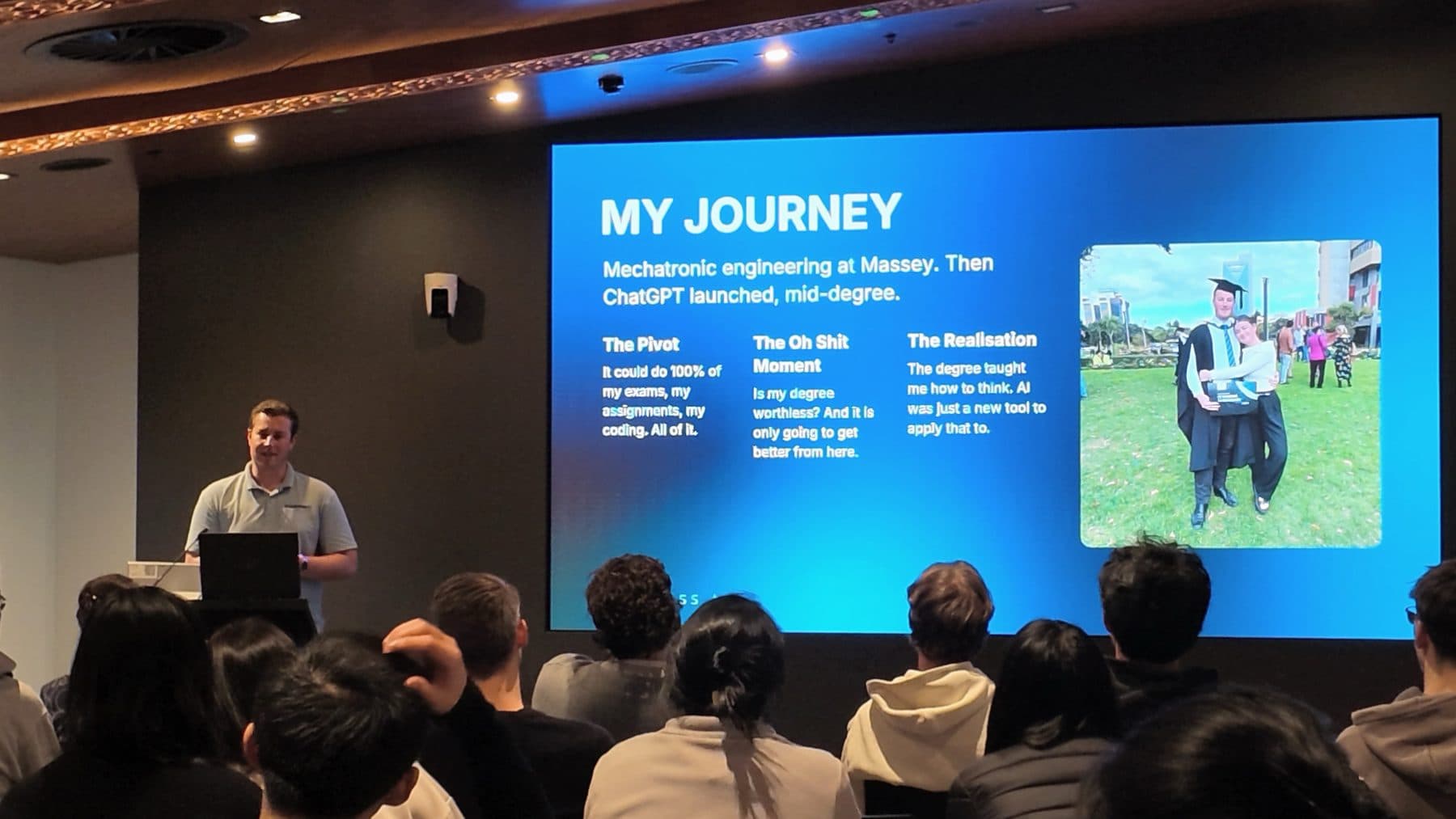
Mine is in mechatronic engineering from Massey. Halfway through it, ChatGPT launched and could do basically all of my exams, my assignments and my coding. For a while I honestly wondered whether the degree was worthless. It was not. It taught me how to think and how to pull a problem apart, and AI turned out to be a new tool to apply that thinking to. Nothing in the degree taught me AI itself.
What a degree is not is the only way in. Some companies, mostly smaller businesses, consultancies and startups, will hire people without one if they can show proof that they can do the work. Look at the people who have spoken at our meetups. Georgia switched out of computer science after an advisor told her she was not smart enough to work in AI, and she is now an AI engineer at Trade Me. Brodie tried life as a stockbroker first. Lachie Christie came through mechanical engineering and a design-thinking degree in Sydney. Caleb Wharton started in accounting. None of them has an AI degree, largely because the field is too new to have grown a standard path.
On the AI delegation to China this year we put the question to a Distinguished Professor at one of their top universities: what should young people actually study? The answer was that the subject matters far less than whether you are using AI alongside it. So whatever you are studying, or not studying, the common thread is the same. The people who get in built things and talked to people.
Your first month: get genuinely fluent with the tools
Pick one assistant, Claude or ChatGPT or whatever you already have access to, and use it for real work every day for a month. Not for novelty. For your assignments, your job, the admin you keep putting off. You are building an instinct for what these models are good at, where they fall over, and how much context you need to give them before the output is worth having. Treat it like a smart intern: capable and fast, brand new to your world, and in need of context, examples and having its work checked.
YouTube is a free, world-class AI course, and it is how I learned most of this. But watching is not learning. The question that makes it stick is always "how do I use this for the thing in front of me?"
Then get on a coding tool. Claude Code and Cursor are the two most people in our community use. You do not need to be a strong programmer to start, which is exactly the point, but you do need to read what comes out and understand it. There is a real difference between someone who can prompt their way to working software and someone who ships whatever the model produced without checking. An interviewer can tell which one you are within about ten minutes.
Then learn one automation tool. n8n is the one I reach for most, and it is free to learn. Being able to wire a trigger to a few steps to an output is the skill almost no graduate has and almost every business needs, and it will do more for your employability here than another certificate will.
Do not try to learn all of it at once. Georgia's advice at our May session was to pick one thing and go deep, because most tools are the same thing in a different font and the skills transfer. She is right, and trying to keep up with everything is the fastest way to burn out without learning anything properly.
Your second month: build something small and real
The strongest thing you can put in front of an employer here is something you built that a real person uses. Not a tutorial you followed. Something with a user, even if that user is your mum.
My first build was Glow for Less. My partner spends a fortune on makeup, and I noticed the same ingredients turning up in much cheaper brands, so I built a small app that scans a product, reads the ingredient list and finds cheaper alternatives. It had nothing to do with engineering and it was not perfect. It was real and it was shipped, and that one project started the whole chain for me, because it is what got noticed.
The formula is simple. Find a real problem in your life or in the life of someone close to you. Build the smallest possible version, and let it be ugly. Then tell people about it. Three rules for a good first project: it solves a problem for a real person you can talk to, so you get feedback instead of guessing; it is small enough that you finish it, because an unfinished project proves nothing; and you can demo it in about sixty seconds, because that is roughly how long you get in an interview or standing at a meetup.
If you are stuck for ideas, look at the organisations around you. A family business, a sports club, a flat, a student association, the place you work part-time. Every one of them has someone doing a repetitive job by hand that they would love to stop doing.

Learn in public, because right now nobody knows you exist
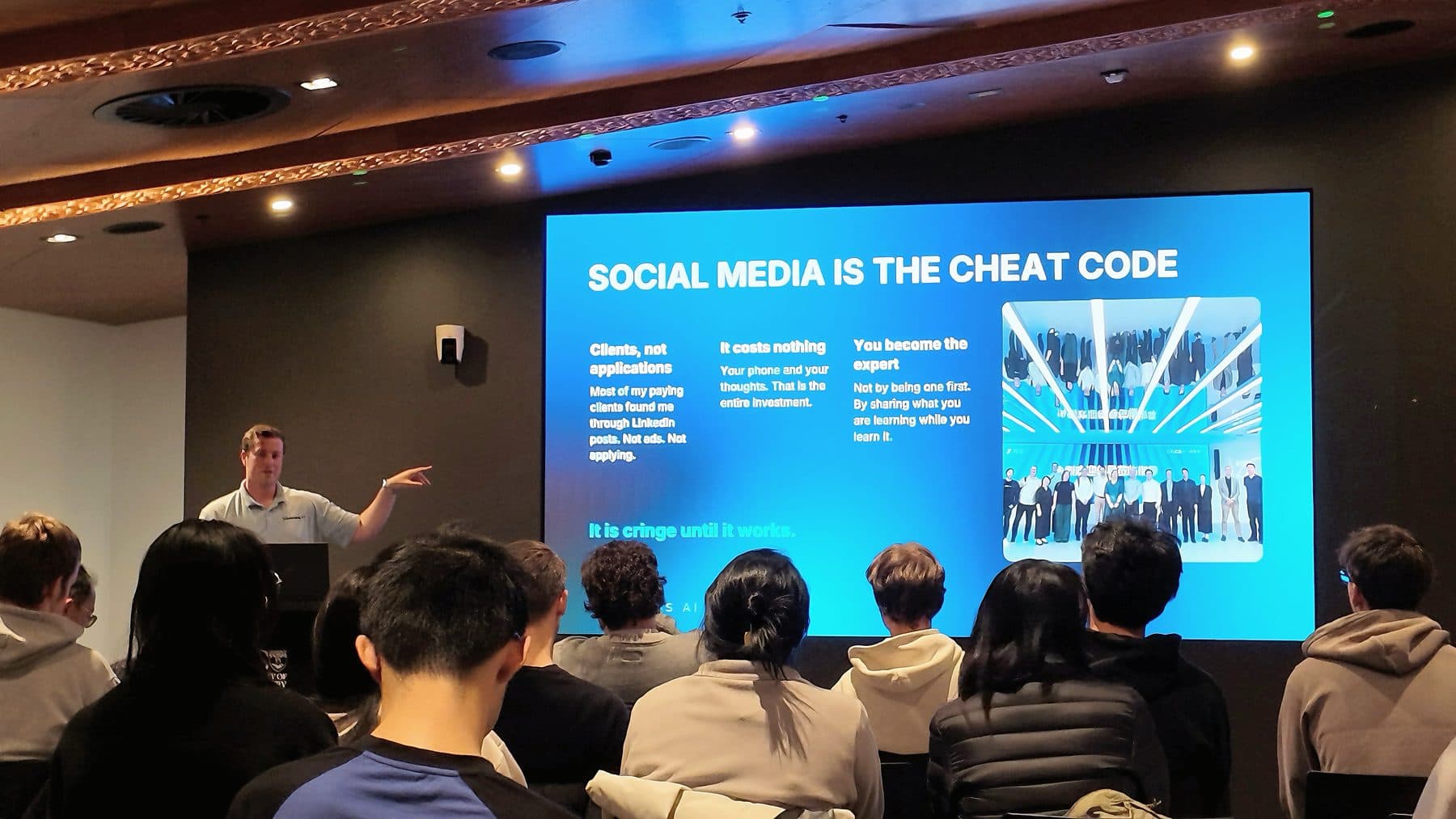
Being good at the work is not enough on its own, and this is the part almost everyone skips. Social media is the cheat code. I started posting what I was learning on LinkedIn and YouTube in May 2025, not as a personal brand play but because I wanted to teach anyway. Within six months I had seven job offers, one of them at double my salary. All of it inbound, with no applications and no ad spend. Most of my paying clients at Harkness AI have found me the same way.
It does not work because I am good at making videos. The early ones are still up and they are genuinely bad. It works because almost nobody in New Zealand posts about the actual technical work they do day to day. It costs nothing but your phone and your thoughts, the audience is small, and it is exactly the right people.
There is a newer reason too. Employers with a hundred applicants increasingly paste the CVs into an AI and ask it to compare them, and that AI goes looking for more on each name. If there is nothing to find, all it has is your CV, which looks like everyone else's. If you have a LinkedIn full of real projects, it pulls those in and you win a comparison you never saw happen.
You do not need an audience or a content strategy. Post what you built this week and what broke. If you are a student, post what you are learning and what confused you. It feels cringe. It is only cringe until it works, and if a post lands you a job it was never cringe in the first place.
Talk to people, and make the ask small
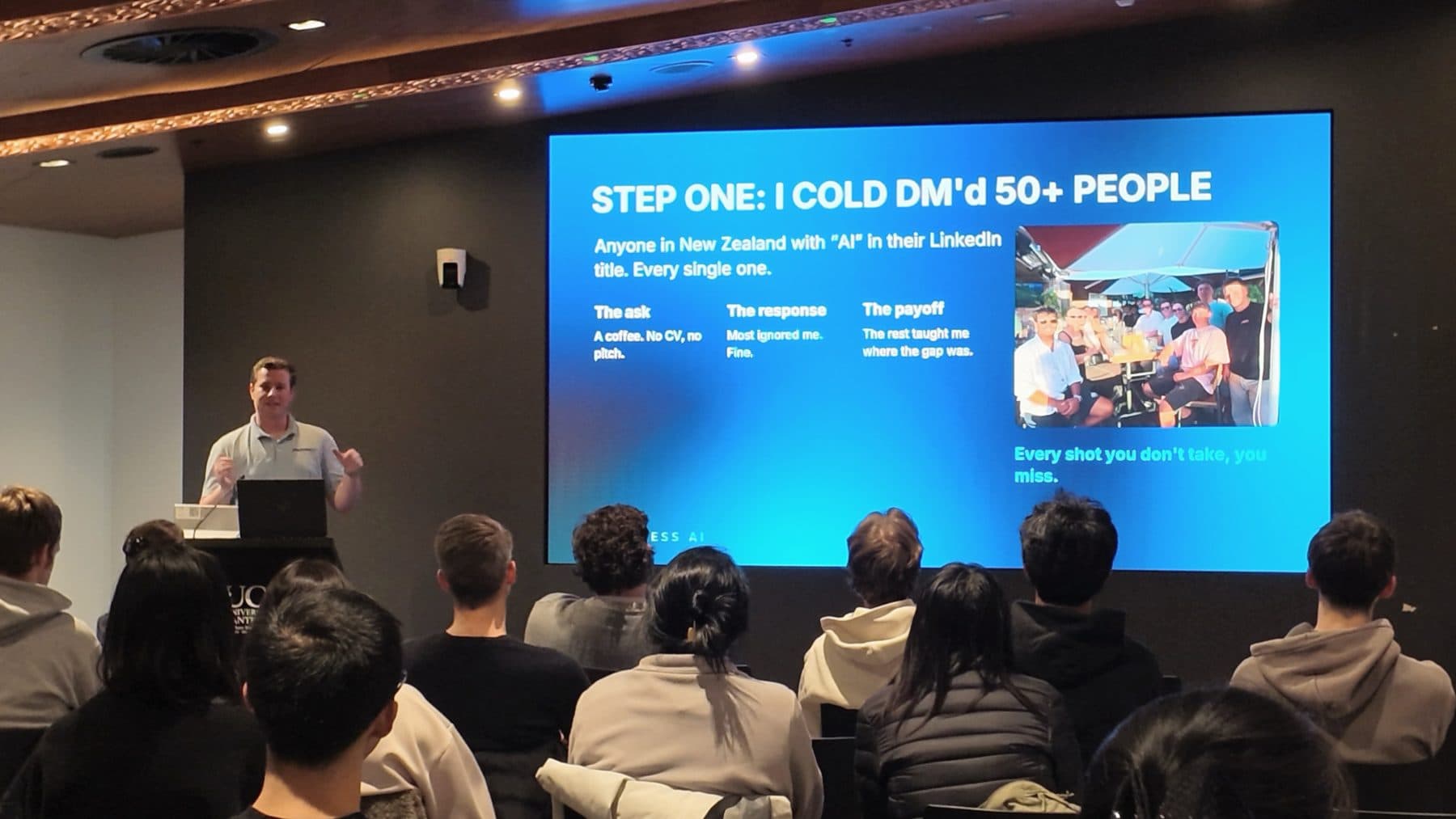
When I started as a graduate engineer the brief was literally "go do AI", and nobody in the building knew what that meant. So I searched LinkedIn for anyone in New Zealand with AI in their title and messaged every single one of them asking for a coffee. That was somewhere between 50 and 100 people. Most ignored me, which is fine. Every shot you do not take, you miss.
The ones who said yes taught me the industry: what people actually build, what companies actually pay for, and where the gap was. The point was never to ask for a job. My fractional role at Patersons came out of one coffee chat. My first paying client came from one YouTube video. One LinkedIn message showed me the gap in the market. None of them looked like much at the time, and that is the thing about these conversations, they compound.
Make the ask small and specific. Twenty minutes about what their team is actually building beats a paragraph about how passionate you are about AI. And turn up in person. Our AI meetups are free and run right across the country, and standing in a room with people who do this work is worth more than a month of scrolling. We have run them in Auckland, Christchurch, Hamilton, Dunedin and Palmerston North, and if there is not one near you yet, the community Discord is where members swap roles, projects and introductions in between.
Where the roles actually are
The hard part of finding an AI job here is that most of them are not advertised as AI jobs. They go out as graduate software engineer, data analyst, digital specialist or automation lead, with the AI work buried in the responsibilities. I have gone through where to look and how to approach it in Where to find AI internships and graduate roles in NZ.
Businesses keep asking me to find them AI talent and students keep asking me to find them AI roles, and I still cannot match the two up fast enough. The demand is real. The bottleneck is proof, not vacancies.
Do you need a masters?
It depends entirely on what you want to do. If you want to work in research, or you want to work overseas where the credential carries more weight, then it is worth it, and a good supervisor is worth a lot on its own.
If you want to build things for New Zealand businesses, think hard about it. A multi-year programme in a field that shifts every few months is a big bet, and the years of building and networking you give up are not free. That is a trade-off, not a rule, and plenty of people do both. Just be honest with yourself about which problem the qualification is actually solving. If you are weighing up study options, I have gone through them in AI courses in New Zealand: an honest guide.
The bit that actually matters
Nearly everything above is a variation on one idea: start before you feel ready. Every person I have hired, and every person I have watched get hired, did something before anyone asked them to. Alexander Russell wanted to break into AI engineering and ended up contracting on real client projects. Zavier Taylor was a first-year engineering student at Canterbury who messaged me saying his lecturers were not teaching any AI, and offered to work for free. Almost nobody offers that, so I got him upskilled and he ended up on a contract. Yushi Chen, an AUT graduate, built a full-stack AI coding agent platform, and I introduced him to Lachie at GrowLab in Auckland, where he is now an AI developer. None of them had a perfect CV. All of them did something visible first.
You are not behind. Generative AI is only about four years old, so someone with twenty years in the industry has at most four years with this. Nobody has it figured out, including the people who sound like they do. Pick a tool, build something small, tell someone about it, then do it again. If you would rather not do that alone, come and join us. It is free, and there is no catch. If you have got questions about how the community works, the FAQ covers most of them. And if you are reading this from the other side, as an employer trying to find AI talent rather than become it, Harkness AI's hire AI talent page covers how businesses recruit from this community.